
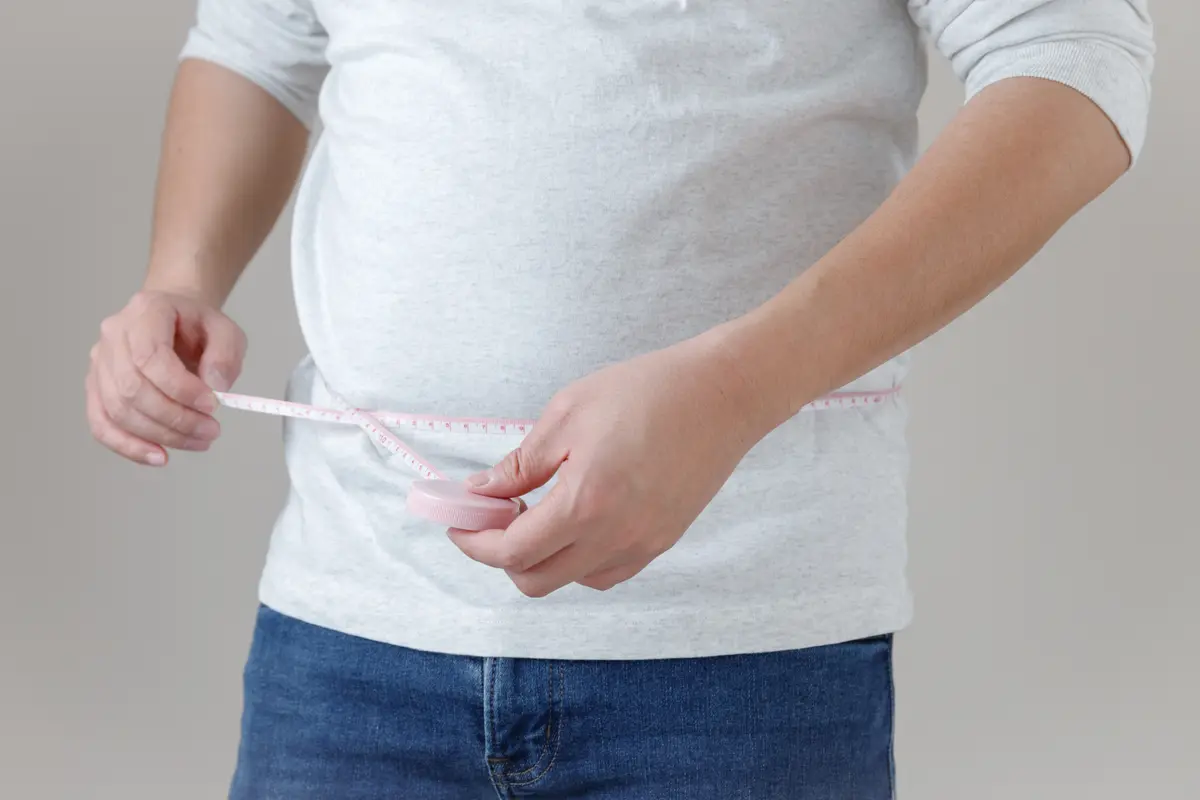
How much can losing weight raise testosterone?
Losing weight can raise testosterone by a meaningful amount, and the bigger the loss, the bigger the rise. Excess body fat converts testosterone into estradiol and quiets the brain’s signal to the testes, so taking fat off tends to release that brake.
A 2017 review in the Journal of Clinical Endocrinology and Metabolism pulled together the clearest numbers:
| Source of data | Weight lost | Change in total testosterone |
|---|---|---|
| Diet studies, pooled | 9.8% on average | Up about 84 ng/dL |
| Bariatric surgery, pooled | 32% on average | Up about 251 ng/dL |
| European Male Ageing Study | About 5% | Up about 58 ng/dL, free testosterone unchanged |
| European Male Ageing Study | More than 15% | Up about 164 ng/dL |
The 2013 meta-analysis behind the pooled figures found that the amount of weight lost was the strongest predictor of the testosterone gain, and that LH and FSH rose while estradiol fell. The studies were small and short, so treat these as averages. A man starting at 270 ng/dL has a realistic shot at normal after a 10 percent loss; a man starting at 150 ng/dL probably does not.
Why would you hold off on testosterone therapy?
Holding off keeps your options open. Testosterone from outside the body tells the pituitary to stop sending LH, so your own production and sperm output fall while you take it. If you start first, you lose the chance to learn whether weight loss would have fixed the number on its own.
The 2017 review calls lifestyle measures the first-line approach for obesity-related low testosterone, and says testosterone should start either together with a trial of lifestyle change or after that trial fails. Fertility adds weight to the decision: the American Society for Reproductive Medicine warns that testosterone use can lower sperm counts.
When does a GLP-1 program first make more sense?
A GLP-1 program first fits a specific pattern: a BMI in the obesity range, total testosterone that is low but not very low, LH and FSH that are normal or low rather than high, and metabolic signs such as rising A1c or high triglycerides. That picture points to functional hypogonadism driven by weight, which is the kind most likely to recover.
There is head-to-head evidence. In a 16-week randomized study of 30 men with obesity and low testosterone, liraglutide raised total testosterone by an average of 2.6 nmol/L and testosterone gel by 5.9 nmol/L. Only the liraglutide group lost real weight, 7.9 kg against 0.9 kg, and only that group saw LH and FSH rise, meaning their own production picked up. Both groups reported better sexual function. Our comparison of weight loss and TRT for low testosterone weighs the trade-offs in more depth.
When do both together make more sense?
Running both at once fits men whose testosterone is clearly low on repeat morning tests and whose symptoms are hurting work, mood or relationships now. It also fits men who have already put serious effort into weight loss without the number moving, and men for whom fertility is not a concern.
Combining them needs closer monitoring, including blood pressure, hematocrit and how each treatment affects appetite and energy. Our answer on taking semaglutide and testosterone together covers what gets watched. If your level stays low after you have lost weight and kept it off, our lab guide to testosterone after weight loss explains which markers help find the reason.
How Ultimate Male decides the order
At our San Gabriel and Downey clinics, both questions get answered in one evaluation. The TRT pre-screening panel checks total testosterone, estradiol, PSA and a complete blood count, and your provider adds free testosterone, SHBG, LH and FSH when the picture calls for it. A body composition scan and metabolic labs show how much of the problem is weight.
From there, a PA-C or MD lays out the order that fits you: medical weight loss first with a planned testosterone recheck, testosterone therapy now, or both with shared monitoring. A consultation is an evaluation, not a promise of any treatment. To talk through your numbers first, call 626-319-5261 and ask for the free 10-minute phone call.