
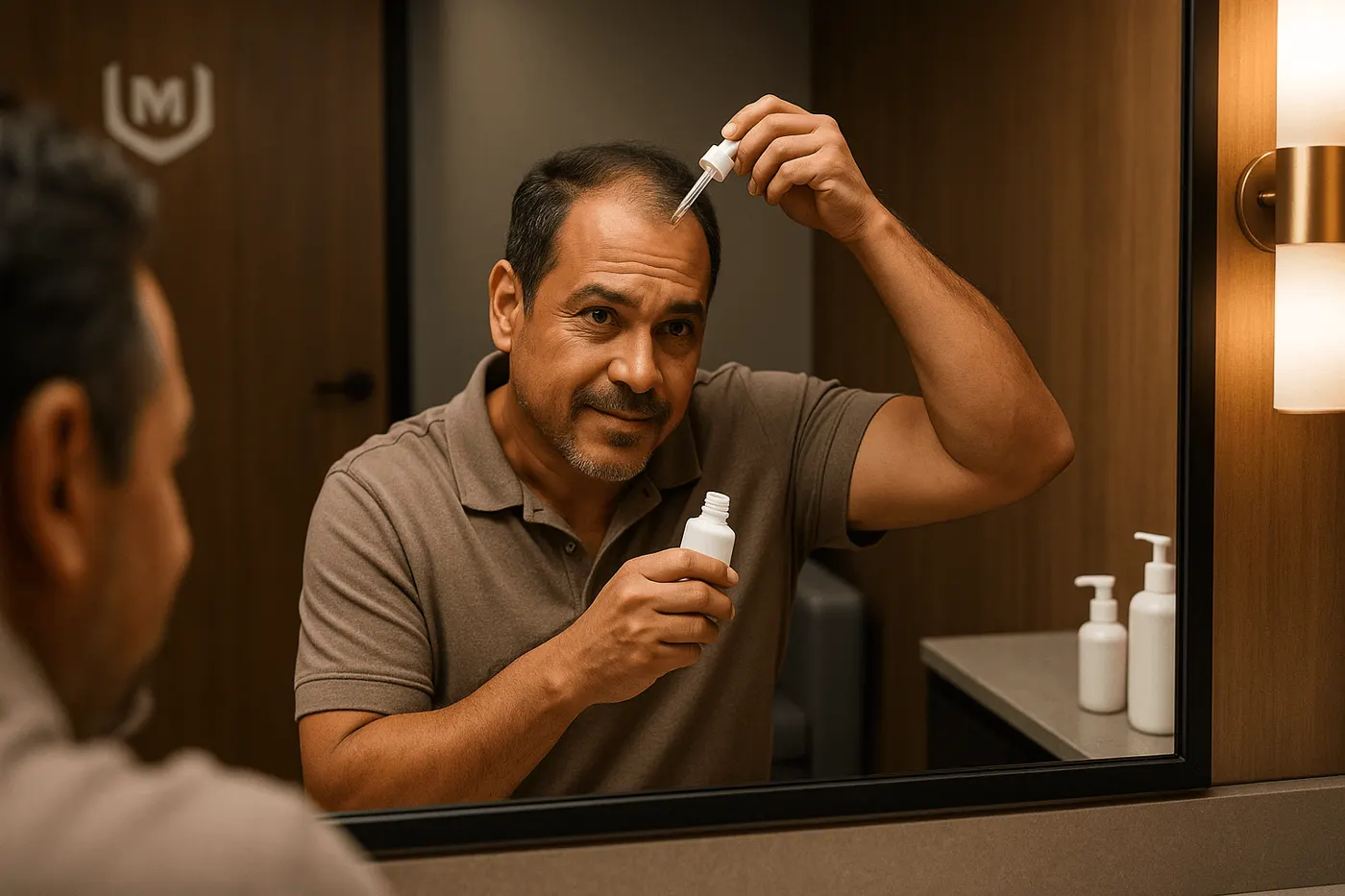
Why pair a topical with PRP?
Because each one works on thinning hair in a different way, and men often want more than a single product. Hair loss does not just affect your appearance; it can affect your confidence and how you feel in social settings. At Ultimate Male, we know how personal it is, which is why the approach here is supervised by a licensed provider and built around your pattern rather than a one-size-fits-all kit.
A typical plan combines a medical-grade topical with platelet-rich plasma (PRP) therapy. The goals are to slow further loss, support thicker growth in thinning areas, and protect the hair you still have. How far a plan gets you depends on the cause and stage of your hair loss, which is why it starts with an evaluation.
What is in the topical hair loss solution?
The compounded topical described in this post combines four ingredients, each aimed at hair loss from a different angle. Your provider decides whether a compounded formula fits you and at what strengths, or whether a standard over-the-counter minoxidil product is the better starting point.
Minoxidil
Minoxidil is the anchor ingredient. It widens small blood vessels and helps keep follicles in their growth phase. MedlinePlus notes that it is used to stimulate hair growth and slow balding, that it tends to work better in men under 40 whose loss is recent, and that most regrown hair is lost within a few months of stopping.
Tretinoin
Tretinoin, a vitamin A derivative, speeds skin turnover. It is included in some formulas to help minoxidil penetrate the scalp. It can also cause dryness or irritation, which your provider will ask about at follow-up.
Progesterone
Progesterone appears in some compounded hair formulas on the theory that it can dampen DHT activity in the scalp. Evidence for this in men is limited, so treat it as a supporting ingredient rather than the main engine of the formula.
Finasteride
Finasteride blocks 5-alpha reductase, the enzyme that turns testosterone into DHT. Applying it to the scalp is meant to concentrate the effect there, but the FDA warned in April 2025 that there is no FDA-approved topical finasteride, that topical finasteride is expected to reach the bloodstream, and that reported side effects resemble those of the pill, including sexual and mood effects. It can also transfer to others by skin contact, which matters for anyone who could become pregnant.
Why combine these ingredients?
Male pattern hair loss is driven mainly by inherited follicle sensitivity to DHT, so a formula that pairs a growth stimulant with a DHT-lowering ingredient targets both sides of the problem. A combined topical can also mean one daily step instead of several. It does not remove the risks of finasteride, and it is a compounded product, so the clinic talks through those trade-offs before you start.
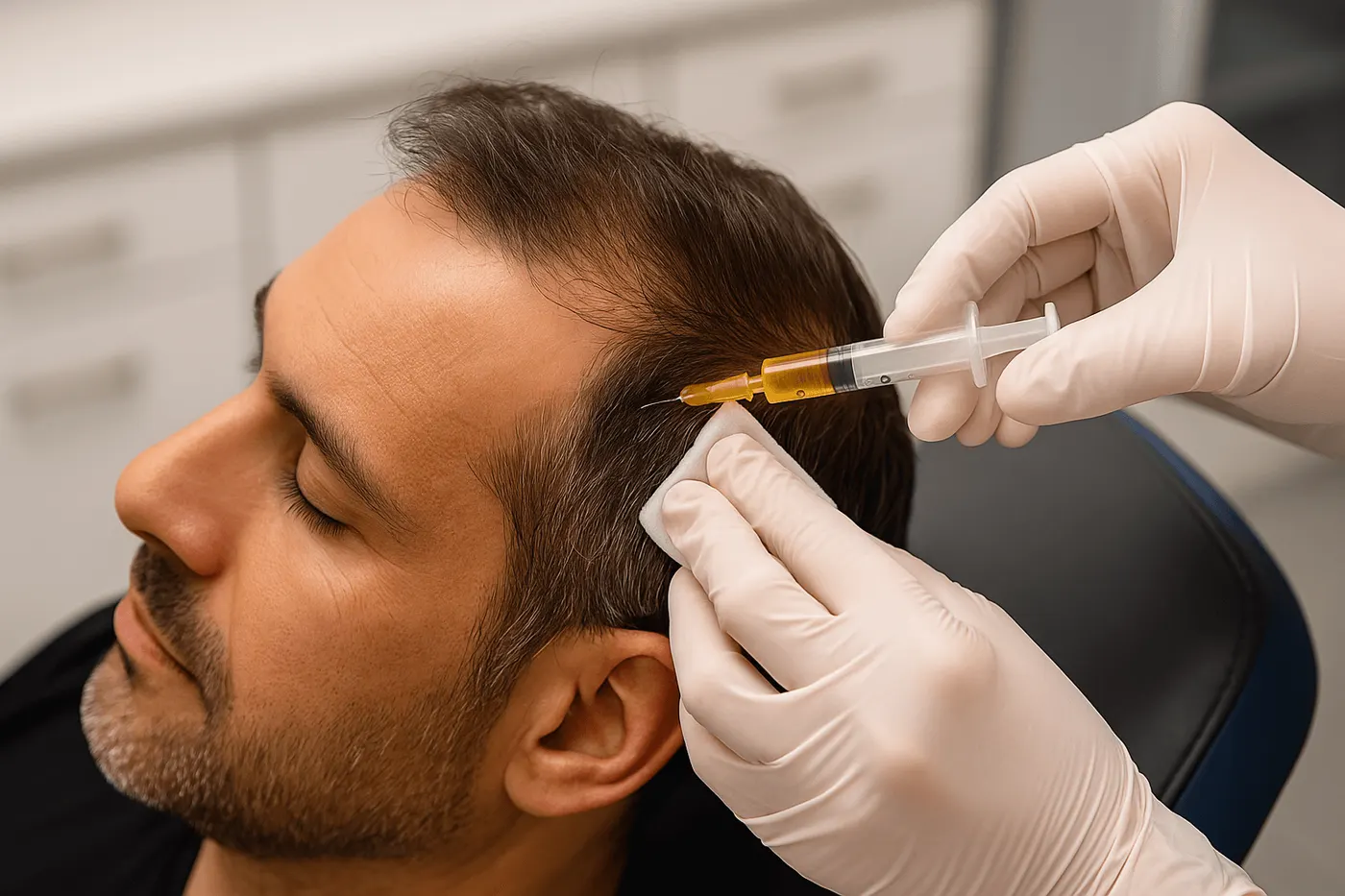
How does PRP hair restoration work?
PRP uses a concentrate of your own platelets, which carry growth factors, to support follicles in thinning areas. For men who want to get more from a topical plan, it adds an in-clinic treatment on a set schedule.
How a session works:
- We draw a small sample of your blood.
- It is spun in a centrifuge to separate the platelet-rich plasma.
- The PRP is injected into thinning areas of the scalp after numbing.
The American Academy of Dermatology says PRP can help lessen hair loss within a few months and that some patients see thickening or regrowth. It also notes PRP is not a permanent solution and describes monthly visits for the first three months, then a return every three to six months. PRP is not FDA-approved for hair loss, and study results are mixed to promising, so your provider will be clear about what it can and cannot do. It can be used alongside minoxidil or finasteride.
Why combine topical treatment and PRP?
Used together, a daily topical and periodic PRP cover different parts of the problem: the topical works every day, and PRP adds a concentrated boost at each visit.
| Piece | How often | What it is for | FDA status |
|---|---|---|---|
| Topical minoxidil | Daily | Growth support, slowing loss | FDA-approved for hair loss |
| Compounded topical blend | Daily | Growth support plus local DHT reduction | Not FDA-approved |
| PRP sessions | Monthly to start, then every few months | In-clinic follicle support | Not FDA-approved for hair loss |
Your provider sets the schedule and the number of PRP sessions based on your pattern and how you respond, and reviews progress at planned check-ins.
What to expect at Ultimate Male
At our clinics in San Gabriel and Downey, hair restoration is private and overseen by a licensed provider. The process includes:
- a hair loss consultation to look for the root cause, since stress, thyroid disease, illness, some medicines and nutrient gaps can all cause shedding, as the American Academy of Dermatology lists;
- a treatment plan that may include a topical, PRP or both, if appropriate;
- progress photos at set points, with optional blood work when the history suggests a medical cause.
We aim to treat hair loss early, whether it shows up as a thinning crown, receding temples or diffuse shedding. If your thinning is sudden, patchy or comes with a sore, scaly scalp, the first step is a medical look at the cause rather than a cosmetic plan. Our PRP for diffuse hair thinning page covers that pattern in more detail.

How do you pay for hair restoration?
Ultimate Male is a direct-pay clinic that does not bill insurance, and treatment for appearance is generally not FSA or HSA eligible: IRS Publication 502 lists hair transplants among the expenses you cannot include. You pay per visit with no membership, financing is available through CareCredit, Prosper Healthcare Lending and Afterpay, and you get a quote before booking. The PRP hair restoration cost page explains what drives the total.
Start with a hair loss consultation
You deserve more than guesswork with a generic foam. Our hair restoration program starts with a look at why your hair is thinning, then a plan that fits your pattern, budget and comfort with each treatment.
Call or text 626-319-5261 for a free 10-minute phone call, or book a consultation at San Gabriel or Downey. If you are weighing options, our PRP vs minoxidil comparison is a useful read before your visit.