
The short answer: measure, replace, and know the red flags
Summer in the San Gabriel Valley regularly pushes past 100°F, and inland heat builds through the afternoon when the sea breeze never quite arrives. For men who run the foothill trails, ride, play weekend ball or work outside, the plan is simple to describe: know how much you sweat, replace most of it with fluid and salt, avoid drinking far more than you lose, and treat confusion or collapse as an emergency.
What follows is the practical version, built on sports medicine and California workplace rules.
Step 1: Find your sweat rate
Sweat rates vary enormously from one man to the next, which is why generic advice like “eight glasses a day” falls apart in real heat. The American College of Sports Medicine position stand recommends a customized plan and a simple way to build one: weigh yourself before and after exercise.
Here is how to run the test on a typical hot session:
- Weigh yourself nude or in dry shorts right before you start.
- Track everything you drink during the session.
- Towel off and weigh yourself again right after.
- Each pound lost is roughly 16 ounces of fluid. Add what you drank to get your total sweat loss.
- Divide by the hours you were out to get your hourly sweat rate.
Do this a few times in different conditions. A man who loses three pounds in an hour of yard work at 3 p.m. in August needs a very different plan from one who loses one pound on an early-morning jog.
Step 2: Plan fluids and electrolytes
The ACSM’s main goal for drinking during exercise is to prevent excessive dehydration, which it defines as more than 2% of body weight lost from water deficit. For a 200-pound man, that is 4 pounds. Staying under that line protects performance and lowers strain on the heart in the heat.
| Situation | What usually works |
|---|---|
| Under an hour, moderate sweat | Water before and during, normal meals after |
| Over an hour, or heavy salty sweat | A drink with sodium and some carbohydrate during the session |
| Outdoor work shift | Steady drinking all day, plus salty food at breaks |
| After a big loss | Replace the deficit over the next few hours with fluid and salty food |
The ACSM notes that drinks with electrolytes and carbohydrates can outperform water alone in certain situations, and that the speed and size of the deficit decide how aggressively to replace it afterward. Our comparison of IV hydration vs electrolyte drinks covers how those options stack up.
For working men, California sets a floor. Cal/OSHA’s outdoor heat illness standard requires employers to provide enough drinking water for each worker to have one quart per hour for the whole shift, shade when the temperature tops 80°F, and extra high-heat procedures at 95°F and above.
Step 3: Do not overdrink
More is not always better. Drinking far more plain water than you sweat out can dilute the sodium in your blood, a condition called exercise-associated hyponatremia. Guidelines from the Wilderness Medical Society, summarized in American Family Physician, say the usual cause is overhydration with water or sports drinks, that high temperatures raise the risk of both hyponatremia and heat illness, and that the most reliable advice is to drink in response to thirst.
That fits with Step 1. If you weigh more after a session than before, you drank too much. Mild hyponatremia can look like bloating, headache and nausea, which men often mistake for dehydration and treat with even more water.
Know the signs of heat illness
Heat illness tends to build in stages, and the early stages are your chance to stop. MedlinePlus describes the progression:
- Early: muscle cramps, fatigue, thirst and very heavy sweating.
- Heat exhaustion: cool, moist skin, dark urine, dizziness, headache, nausea or vomiting, weakness and a rapid, weak pulse.
- Heat stroke: the body can no longer control its temperature, and it keeps rising.
Call 911 right away for a temperature above 104°F, confusion, irrational behavior, slurred speech, seizures, extreme lethargy or unconsciousness. While you wait, move the person to a cool place, cool the skin with water and a fan, and put cold packs on the neck, groin and armpits. Do not wait for an IV. Cooling comes first.
When IV fluids are and are not the right tool
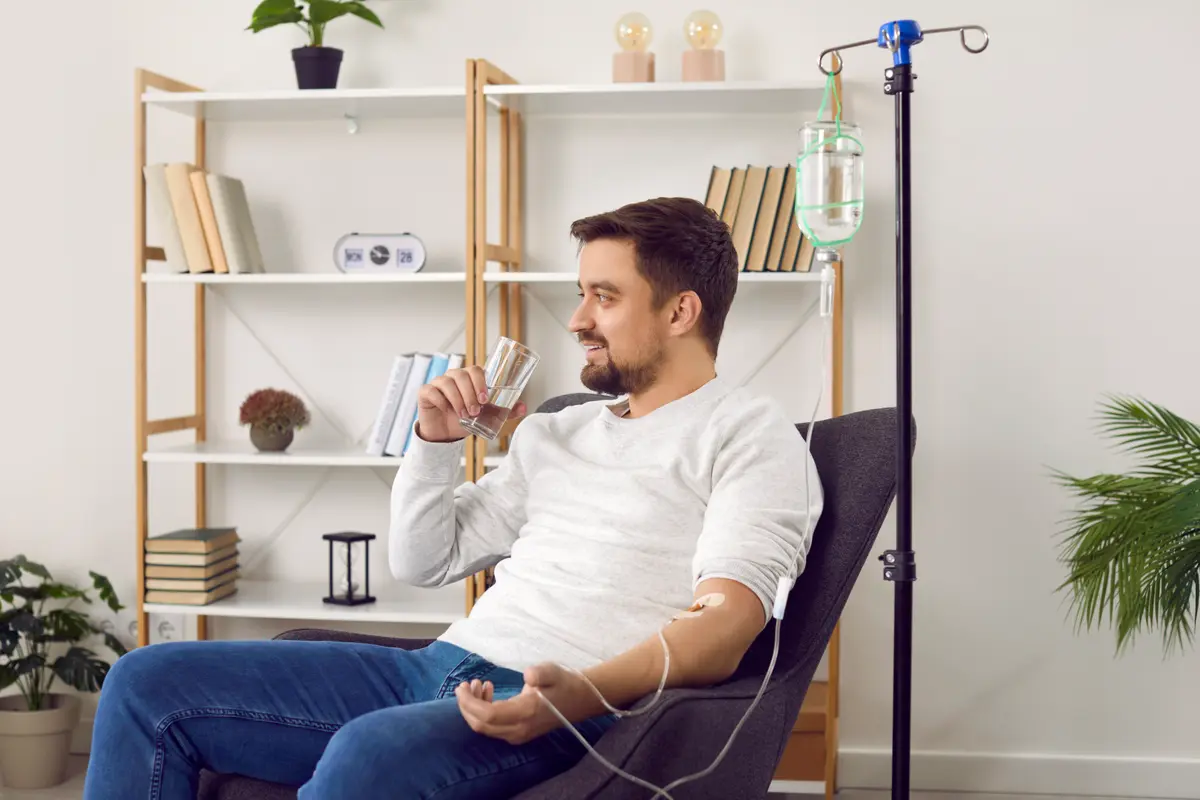
IV fluids have a real but narrow place in heat season. A review comparing IV and oral rehydration in athletes found that IV fluid restores hydration markers faster, but the advantage is usually small and short-lived, and it did not improve later exercise performance more than drinking. Oral fluids also trigger thirst and hormone signals that IV fluids bypass. The same review notes that voluntary IV rehydration is restricted under anti-doping rules, which matters for tested athletes.
IV fluids are not the right tool for heat stroke, confusion, chest pain or fainting, all of which need an emergency department. They are also a poor choice when hyponatremia is possible: the Wilderness Medical Society guidance says hypotonic or isotonic IV fluids should be avoided in suspected mild hyponatremia.
They can make sense for a stable man who is clearly dehydrated, is thinking clearly, and has trouble catching up by mouth, after a clinician has checked his history and, ideally, his labs. Our answer on IV hydration after heat exhaustion covers that window. Men on semaglutide or tirzepatide often eat and drink less, so our article on GLP-1 medicines in a heat wave is worth a read too.
How Ultimate Male helps in the hot months
At our San Gabriel and Downey clinics, a hydration IV is offered only after a provider reviews your symptoms, medicines and history, and anyone with emergency signs is sent to the ER instead. For men who train or work outside all summer, a visit can also cover a sweat-rate plan, a medicine review for heat risk, and labs such as kidney function and electrolytes. Our page on IV therapy explains the formulas available, and the rules every California IV clinic should follow are laid out in our article on IV drip bars in California.
