
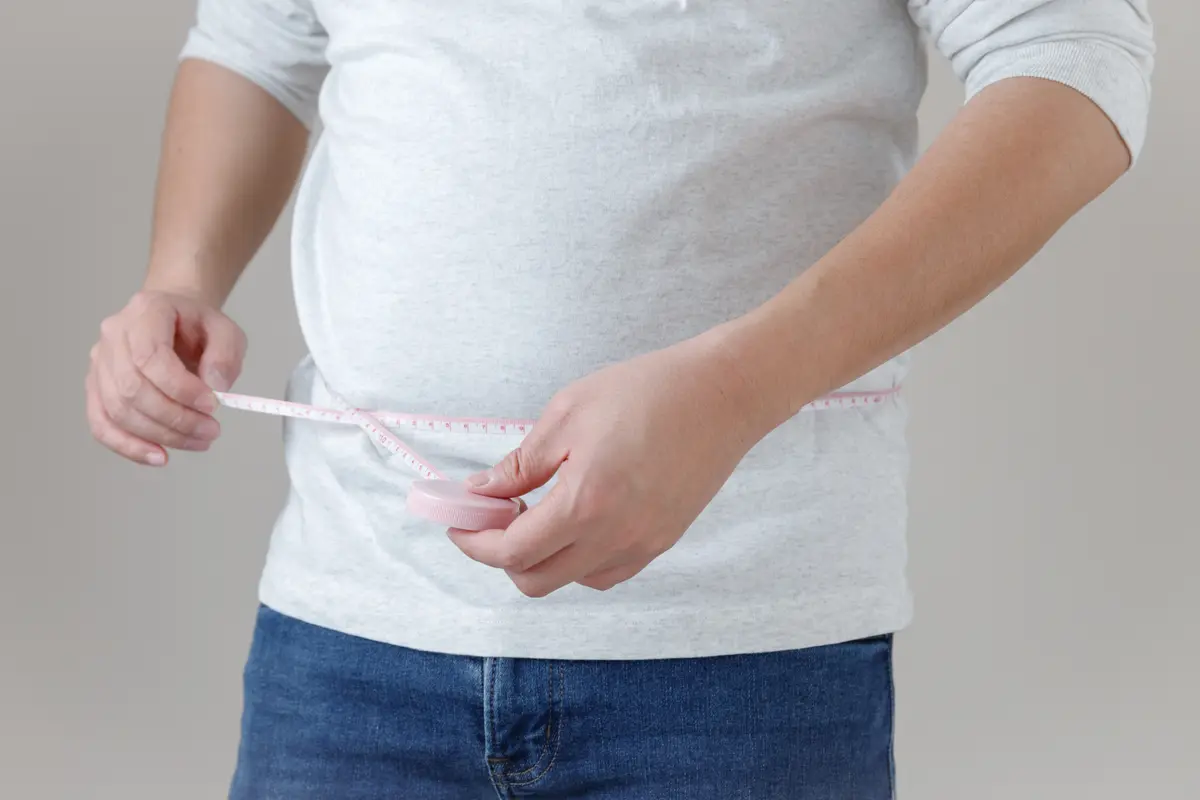
How excess body fat lowers testosterone
Body fat is not inert storage; it actively changes hormone levels. Two mechanisms do most of the damage, and they reinforce each other.
Fat converts testosterone into estradiol. Fat cells carry an enzyme called aromatase. A 2019 review of obesity-related hypogonadism explains that obesity increases aromatase in fat tissue, which speeds the conversion of testosterone to estradiol. More fat means more conversion.
The brain’s signal to the testes gets quieter. The same review describes how higher leptin, insulin, inflammatory signals and estradiol suppress the hypothalamus, which then sends a weaker message through LH (luteinizing hormone) to the testes. The testes themselves are usually healthy; they are simply being told to make less. This is why LH is typically not raised in obese men with low testosterone, as an Endocrine Society journal review notes.
A third factor muddies the lab picture. Insulin resistance lowers SHBG, the protein that carries testosterone in blood, so total testosterone can read low even when the free fraction is closer to normal. That is why free testosterone and SHBG are often measured alongside the total.
The cycle runs both ways. Low testosterone makes it easier to gain fat and harder to keep muscle, which adds more aromatase and more suppression. Breaking the loop at either end helps.
Signs that weight and testosterone are linked
The symptoms overlap with low testosterone from any cause, but a few features suggest weight is part of the story:
- A waist that has grown faster than the rest of you.
- Low energy, lower sex drive and fewer morning erections.
- Loss of strength despite training.
- Breast tissue growth (gynecomastia), reflecting higher estradiol.
- Loud snoring or pauses in breathing at night, a sign of sleep apnea, which lowers testosterone further.
Population data show the size of the effect. In the European Male Ageing Study, as summarized in the 2017 JCEM review, overweight men averaged about 66 ng/dL lower total testosterone than lean men, and men with obesity about 147 ng/dL lower.
How much testosterone rebounds after weight loss
Weight loss raises testosterone, and the rise grows with the amount lost. In a 2013 meta-analysis, both low-calorie diets and bariatric surgery increased total testosterone, estradiol fell, and the amount of weight lost was the strongest predictor of the gain.
| Amount of weight lost | Typical change in total testosterone | Source |
|---|---|---|
| About 5% (over 4.4 years, EMAS) | Up about 58 ng/dL | 2017 JCEM review |
| About 10% (diet, meta-analysis average 9.8%) | Up about 84 ng/dL | 2013 meta-analysis, as summarized in 2017 review |
| More than 15% (EMAS) | Up about 164 ng/dL | 2017 JCEM review |
| About 32% (bariatric surgery) | Up about 251 ng/dL | 2013 meta-analysis |
These are averages from small, short studies, and individual results vary. A man starting at 280 ng/dL may move into the normal range after losing a tenth of his weight; a man starting at 150 ng/dL probably will not.
How it is evaluated
Testing for weight-related low testosterone uses the same careful approach as any testosterone workup, plus a look at metabolism:
- Two early-morning total testosterone tests on separate days.
- Free testosterone and SHBG, because low SHBG can make the total look worse than it is. Our page on low SHBG in men explains the pattern.
- LH and FSH to show whether the signal from the brain is the weak link.
- Estradiol and prolactin when the picture calls for them.
- HbA1c, fasting glucose, a lipid panel and liver enzymes to map the metabolic side.
- A body composition analysis, which separates fat from muscle better than the scale.
At Ultimate Male, labs are drawn on site at San Gabriel and Downey with results in 24 to 48 hours.
Treatment paths: weight loss first, TRT when it is needed
For many men the logical first move is a structured weight-loss phase, then a recheck. The AUA guideline recommends counseling every man with testosterone deficiency on lifestyle changes, and the obesity review above notes that aromatase inhibitors and SERMs are not recommended for this problem because consistent trial evidence is lacking.
Ultimate Male’s medical weight loss program uses semaglutide or tirzepatide when you qualify, with labs, body composition tracking and regular check-ins. Testosterone is then retested after a meaningful loss, because the result often changes the decision. Our page on testosterone after weight loss covers timing.
Why the recheck matters
Starting testosterone therapy is a bigger decision than it looks. Testosterone from outside the body signals the brain to cut LH further, so your own production and sperm output fall while you are on it, and many men stay on treatment for years. If a 10 or 15 percent weight loss would have moved your level into range on its own, that is worth knowing first.
The recheck is done the same way as the original tests: early morning, ideally at the same lab, once your weight has been stable for a few weeks rather than in the middle of a rapid drop. Symptoms are reassessed too. Some men find energy and libido return with the weight loss even before the number moves much, while others feel no different and the conversation turns to therapy.
TRT stays on the table. When levels are clearly low with significant symptoms, or remain low after weight loss, testosterone therapy may be recommended, either alongside a weight program or after it. TRT can affect fertility, so men hoping to have children should say so first. The trade-offs are set out in weight loss versus TRT for low testosterone.
When it is urgent
Low testosterone itself is not an emergency, but some problems that travel with obesity are. Call 911 for chest pain or pressure, sudden shortness of breath, or stroke signs such as face drooping, arm weakness or slurred speech. If you nod off while driving, stop driving and get evaluated for sleep apnea promptly, because that risk is immediate.
Your next step
If your waist has grown and your energy and drive have dropped, testing both sides of the problem at once saves time. Book the free 10-minute phone call at 626-319-5261, or use the online assessment to see which labs fit your symptoms. A PA-C or MD then reviews the results with you and lays out whether weight loss, testosterone therapy or both make sense, with a recheck built into the plan.
