
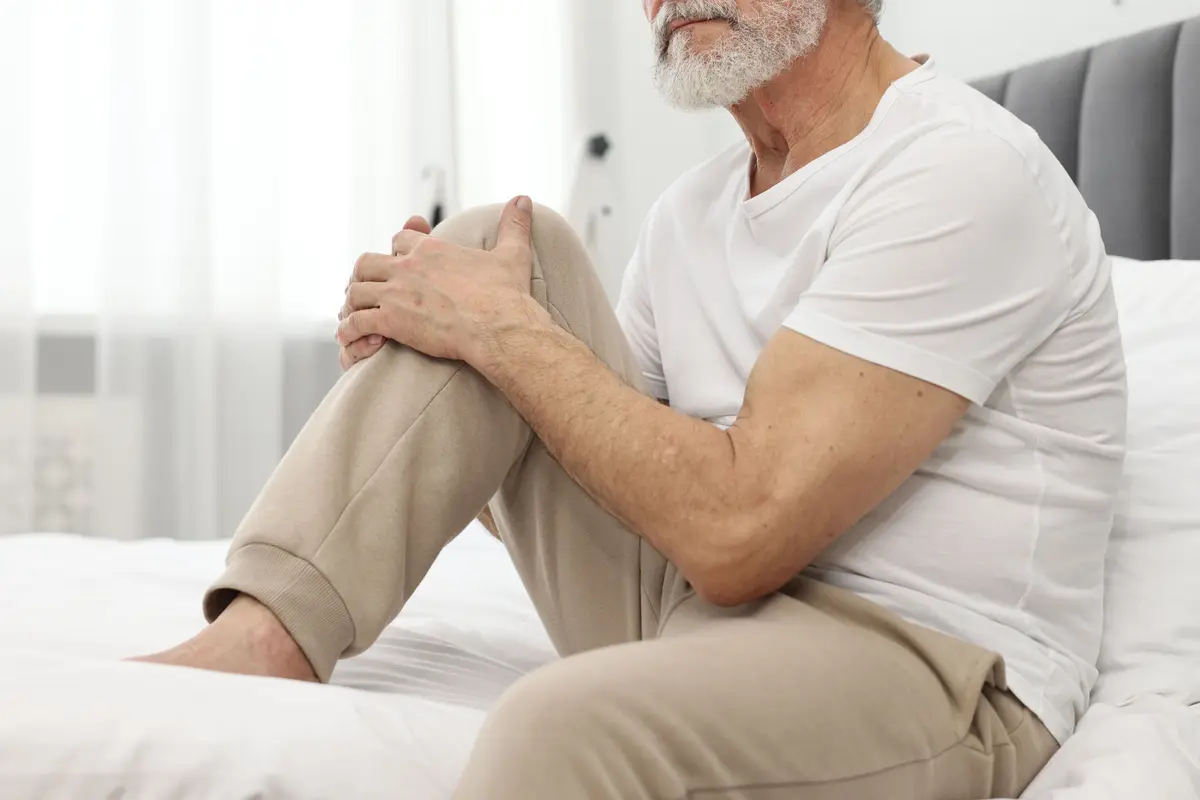
Why lifters get tendon pain
Most tendon pain in lifters is overuse tendinopathy: the tendon is asked to handle more load than it has adapted to, and it becomes painful and irritable. MedlinePlus lists overuse and aging among the causes of tendinitis and notes that degeneration of the tendon, called tendinosis, is often present as well.
The usual trigger is a jump rather than a single bad rep: a new program, a block of high volume, a switch to a different grip, or returning from a layoff at old weights. Tendons adapt more slowly than muscles, so strength can outpace what the tendon is ready for, especially after 40. Typical symptoms are pain along a tendon near a joint that worsens with activity, morning stiffness and tenderness to the touch.
Where it shows up: elbow, shoulder and knee
Lifters tend to develop tendon pain in a few predictable places, each linked to particular movements.
| Area | Common name | Lifts that often provoke it | Typical clue |
|---|---|---|---|
| Outer elbow | Tennis elbow (lateral epicondylitis) | Rows, pull-ups, heavy gripping, deadlifts | Pain gripping, turning a wrench or shaking hands |
| Inner elbow | Golfer’s elbow | Curls, chin-ups, pressing with a tight grip | Pain at the inner elbow with gripping and wrist flexion |
| Front of shoulder | Biceps or rotator cuff tendinopathy | Bench press, dips, overhead pressing | Ache with pressing and reaching overhead, night pain |
| Below the kneecap | Patellar tendinopathy | Deep squats, lunges, jumping | Pain at the start of squats and on stairs |
OrthoInfo notes that tennis elbow is caused by overuse, mostly affects people aged 30 to 50 and is not limited to racquet sports: repetitive gripping and lifting at work or in the gym can bring it on. Our page on tennis elbow goes deeper on that site.
Load changes come first
The first treatment for lifting-related tendon pain is changing the load, not stopping training altogether. That means cutting or swapping the movements that hurt, lowering volume for a few weeks, and then rebuilding with slow, controlled strengthening that the tendon can tolerate.
The track record for this approach is strong. OrthoInfo reports that 80 to 95 percent of people with tennis elbow improve without surgery, using rest from aggravating activities, anti-inflammatory medicine, forearm strengthening with a physical therapist, a counterforce brace and equipment changes. It describes surgery as an option only when 6 to 12 months of nonsurgical care has not worked.
Practical changes that help many lifters:
- switch to neutral or thicker grips, and use straps on heavy pulls for a while
- limit the painful range temporarily, such as box squats instead of full depth
- spread volume across more days rather than one long session
- keep the pain during and after training mild and settling by the next morning
Our page for lifters over 40 covers recovery and programming changes that help keep tendons healthy.
When imaging is needed
Most tendon pain is diagnosed by history and exam, and imaging is added when the answer would change the plan. MedlinePlus notes that ultrasound, X-ray or MRI may be used. OrthoInfo adds that X-rays can check for arthritis, MRI can show tendon damage, and nerve testing can rule out a pinched nerve that mimics elbow tendon pain.
Imaging makes sense when:
- pain has not improved after several weeks of sensible load changes
- there was a sudden pop, bruising or a change in the muscle’s shape
- you have real weakness, not just pain
- numbness or tingling suggests a nerve problem
- an injection or procedure is being considered
Some men consider PRP for tendon and joint repair at this stage. OrthoInfo describes the evidence for PRP in tennis elbow as mixed, and PRP is not FDA-approved specifically for tendon healing.
BPC-157 and TB-500: what the evidence shows
BPC-157 and TB-500 are peptides lifters hear about for tendon healing, and the evidence is far thinner than the online buzz. A 2025 systematic review in HSS Journal found 36 studies of BPC-157 for musculoskeletal injury, 35 of them in animals or cells and only one in people: a small retrospective report in which 7 of 12 patients with chronic knee pain described relief for more than six months. The authors found no clinical safety data and flagged risks from unregulated manufacturing and contamination. TB-500, a synthetic fragment of thymosin beta-4, has even less human research behind it for tendon injuries.
Their regulatory status is unsettled, as of October 2026:
- The FDA removed BPC-157 and TB-500 from its Category 2 list of bulk substances with safety concerns in April 2026, after their nominations were withdrawn. Leaving that list does not by itself make them eligible for compounding.
- On July 23, 2026, the FDA’s Pharmacy Compounding Advisory Committee voted 8 to 6 to recommend them for the 503A bulks list, against FDA staff advice. No final rule has been issued.
- Both are on the WADA prohibited list, so tested athletes should not use them. Our page on peptides banned for tested athletes has more.
Because availability is unsettled, ask on the free call before assuming either peptide, alone or as the Wolverine stack, can be part of your plan. Our 2026 FDA peptide decisions article tracks the rule as it develops, and our comparison of BPC-157 vs PRP for tendon injuries sets the options side by side. Even where peptides become an option, they sit on top of rehab, never in place of it.
When tendon pain is urgent
Some tendon injuries need same-day care. Get urgent evaluation for a sudden pop with immediate weakness, such as being unable to bend the elbow with strength, straighten the knee or push off the foot, or a visible bulge or dent in the muscle; some ruptures repair better when treated early. Go to the ER for a hot, red, swollen joint with fever. Call 911 for chest pain during or after training.
How Ultimate Male approaches lifters’ tendon pain
We start with the tendon, not the peptide. On the free 10-minute call, describe where it hurts, which lifts provoke it and how long it has gone on, and ask about current peptide availability if that is on your mind.
At our San Gabriel or Downey clinic, a PA-C or MD takes a one-on-one history, reviews your training and recommends load changes, physical therapy or imaging first when they fit. Labs are drawn on site when a treatment such as PRP or a peptide is under discussion, with results in 24 to 48 hours. If a peptide is a legal and reasonable option at the time, you get a clear explanation of the evidence, the WADA implications and how follow-up would work.