
What are saline and lactated Ringer’s?
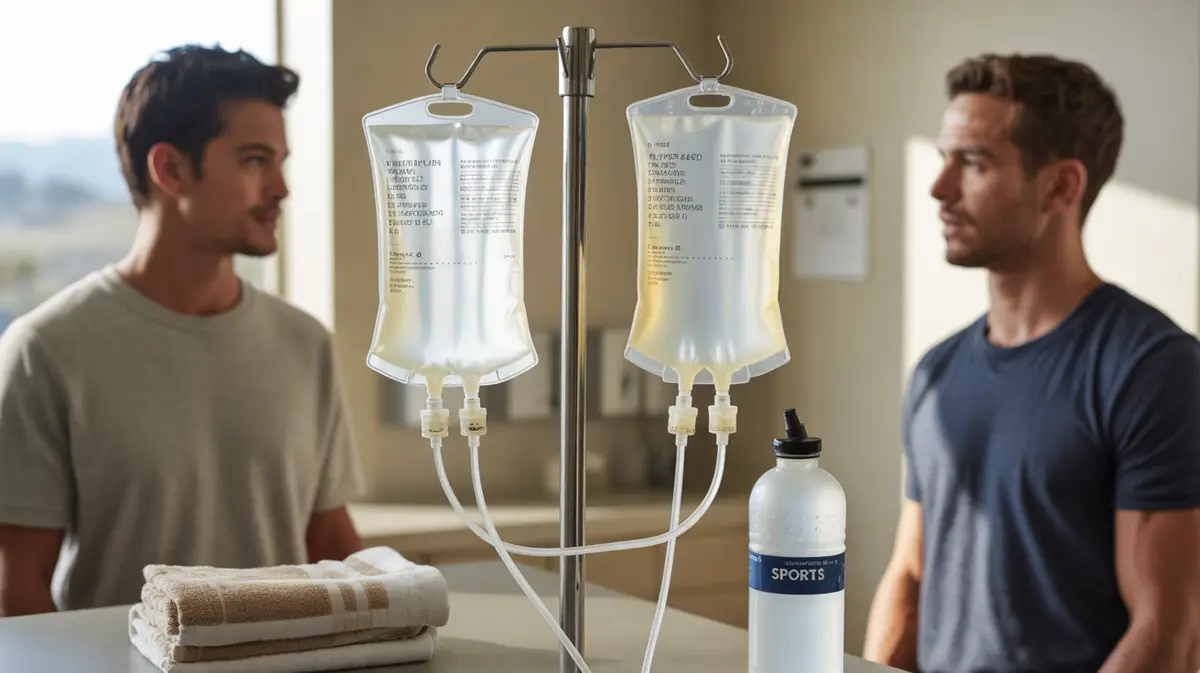
They are the two workhorse fluids behind almost every hydration drip. Normal saline is 0.9 percent sodium chloride dissolved in water. Lactated Ringer’s is a balanced salt solution that adds small amounts of potassium and calcium and swaps some chloride for lactate.
Both are FDA-approved injections with long track records in hospitals, clinics and ambulances. As of October 2026, the saline label describes it as a source of water and electrolytes, and the lactated Ringer’s label adds a second role as an alkalinizing agent. Vitamins or other additives in a wellness drip ride on top of one of these base fluids.
How do the two fluids differ?
The difference comes down to how closely each one matches the salt balance of your blood. Saline carries more sodium and far more chloride than plasma does. Lactated Ringer’s carries a little less sodium than plasma, chloride much closer to plasma, and lactate in place of the missing chloride.
| Per liter | Normal saline (0.9%) | Lactated Ringer’s | Typical blood level |
|---|---|---|---|
| Sodium | 154 mEq | 130 mEq | 135 to 145 mEq/L |
| Chloride | 154 mEq | 109 mEq | 98 to 107 mEq/L |
| Potassium | None | 4 mEq | Small amount |
| Calcium | None | 2.7 mEq | Small amount |
| Lactate (becomes bicarbonate) | None | 28 mEq | Not applicable |
| Osmolarity | 308 mOsmol/L | 273 mOsmol/L | Close to both |
| pH | About 5.0 | About 6.5 | About 7.4 |
The fluid values come from the two product labels. The blood ranges come from MedlinePlus pages on the sodium blood test and the chloride blood test, and normal ranges vary slightly from lab to lab.
The chloride gap is the practical issue. Large volumes of saline can push blood chloride up and lower bicarbonate, a pattern called hyperchloremic metabolic acidosis, which the saline label lists among reported reactions. A single bag in a healthy man rarely causes trouble, but the difference adds up when fluids run for hours or days.
Why is lactated Ringer’s often used after sweat and heat?
Sweat costs you water plus sodium, chloride and a little potassium. Lactated Ringer’s replaces that mix in proportions closer to your own plasma, and the lactate is converted to bicarbonate, which helps buffer the acid that builds up with hard exertion or heat stress. For a man who is dehydrated from a long shift outdoors, a hot race or a stomach bug, that balanced profile is the reason it is a common choice.
The strongest evidence for balanced fluids comes from hospitals rather than hydration clinics. In the SMART trial of 15,802 critically ill adults, patients given balanced fluids had fewer major kidney events within 30 days than those given saline (14.3 percent versus 15.4 percent). The gap was small and the patients were in intensive care, so it supports the chemistry rather than proving a benefit for a single wellness drip.
Saline still has its place. It is the standard partner for blood transfusions, since the lactated Ringer’s label warns against running it through the same line as citrate-preserved blood, and many people do perfectly well with it. Either fluid can rehydrate a healthy adult. If you are weighing an IV against a sports drink, our IV hydration versus electrolyte drinks comparison walks through when each makes sense.
When is extra fluid a problem?
Any IV fluid adds volume to your circulation, and some bodies cannot handle that safely. Both labels warn about fluid overload, and the lactated Ringer’s label names pulmonary edema, fluid backing up into the lungs, as one possible result.
Conditions that limit or rule out a hydration drip include:
- Heart failure or a weak heart muscle, where added volume can bring on breathlessness and swelling. Our page for men with heart disease covers related precautions.
- Severe kidney impairment. Both labels advise avoiding these fluids, because failing kidneys cannot clear the extra water and salt.
- Severe liver impairment. The lactated Ringer’s label advises avoiding it, since the liver converts the lactate.
- High potassium or potassium-raising medicines. Lactated Ringer’s contains potassium and can add to the risk of hyperkalemia.
- Uncontrolled high blood pressure, where a salt and fluid load is unwelcome.
A comprehensive metabolic panel shows sodium, potassium, chloride, kidney function and liver enzymes in one draw, which is why it is a sensible check before routine drips. The full list of exclusions is in who should not get IV therapy.
A warning for endurance athletes: low sodium is not dehydration
After a marathon, a long hike or a hot day of hard labor, confusion, headache, nausea and swelling can come from low blood sodium rather than dehydration. Exercise-associated hyponatremia is usually caused by drinking too much plain water or sports drink, and the Wilderness Medical Society guidance summarized in American Family Physician warns that treating it like heat illness with fluid boluses can dilute sodium further.
That is why a man who looks “dehydrated” after an endurance event needs his sodium checked before anyone hangs a bag. Our article on IV fluids after the LA Marathon covers race-day judgment in more detail.
Call 911 for confusion, seizures, fainting, a very high body temperature or trouble breathing during or after exertion in the heat. Those are emergencies for the ER, not for a hydration clinic.
How Ultimate Male picks the fluid for your drip
At Ultimate Male, IV formulas are built with a provider around your goals and health history, and the base fluid is part of that decision. The clinic has not published a single standard fluid or bag size for every drip, so ask your provider which one your hydration IV will use and why. A good answer will mention what you lost, your heart and kidney health, your recent labs and the medicines you take.
The process starts with a free 10-minute phone call, then a review of your history and, when needed, labs drawn on site in San Gabriel or Downey. Men adding vitamins can read about high-dose vitamin C by IV and vitamin B12 injections and IV before the visit. When you are ready, see the options under IV therapy or call 626-319-5261.
