
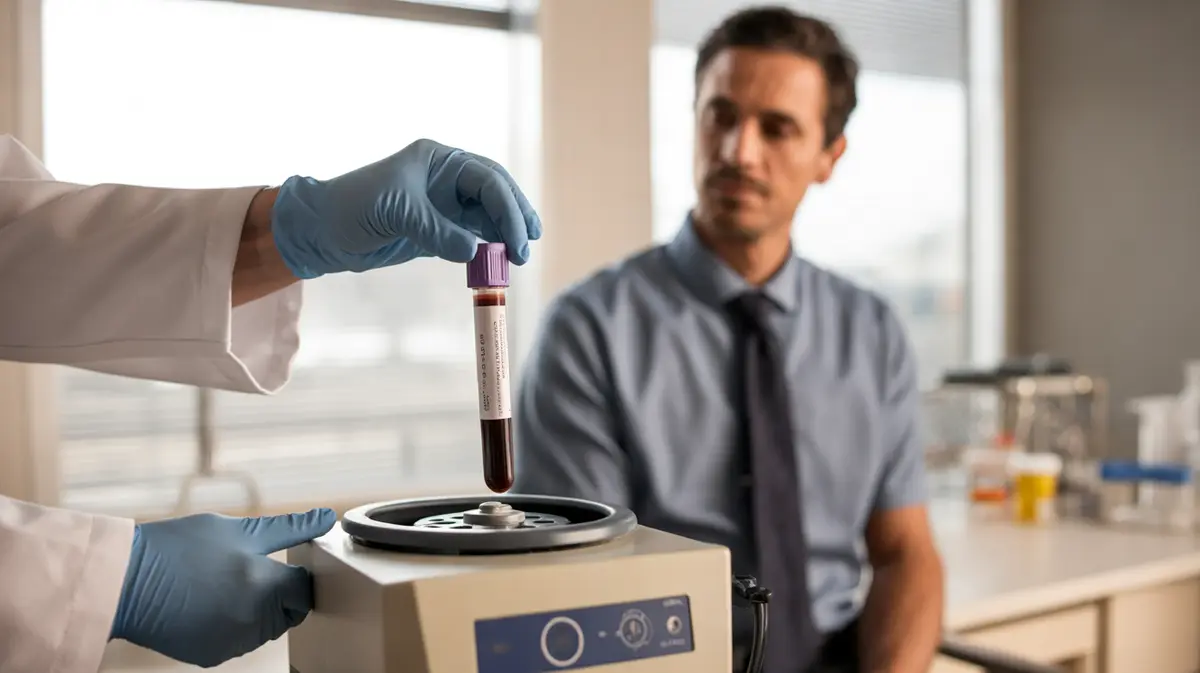
What PRP for ED is, in plain terms
Platelet-rich plasma (PRP) is a concentrate made from your own blood. Platelets carry growth factors involved in tissue repair, and spinning a blood sample separates them into a small volume of plasma. The AAOS describes PRP as having a platelet concentration 5 to 10 times higher than usual blood.
In ED care, that concentrate is injected into the erectile tissue of the penis, the approach often marketed as the “P-Shot.” The idea, drawn mostly from animal research, is that growth factors may support blood vessel and nerve health in the tissue that fills during an erection. It is a reasonable hypothesis. It is not yet a proven treatment, and you should hear that before you book.
What the trials show, honestly
Two placebo-controlled trials frame the evidence, and they disagree.
| Trial | Men treated | Protocol | Result |
|---|---|---|---|
| Poulios and colleagues, 2021 | 60 with mild to moderate ED | Two sessions one month apart | 69% on PRP versus 27% on placebo reached a meaningful improvement at 6 months |
| Masterson and colleagues, 2023 | 61 with mild to moderate ED | Two injections one month apart | No significant difference between PRP and placebo |
The 2021 trial reported no adverse events and a clear benefit over placebo. The 2023 trial found PRP safe but no more effective than a saline injection, partly because the placebo group improved more than expected. Both studies were small, and they used different preparation systems and volumes.
Professional groups have weighed this mixed record. The AUA erectile dysfunction guideline states that PRP for ED should be considered experimental, and PRP is not FDA-approved for this use. The International Society for Sexual Medicine summarizes the evidence as mixed and notes that PRP appears generally safe in qualified hands. Our page on whether PRP works for ED tracks newer studies as they appear.
Who might consider it, and who should not
PRP tends to come up for men with mild to moderate ED, the group the trials enrolled, who want to try something alongside or beyond pills and accept that the benefit is uncertain. Some men pair it with shockwave therapy; our comparison of shockwave and PRP for ED sets out the differences.
It is a poor fit, or needs extra review, if you have:
- A bleeding or platelet disorder, or take a blood thinner
- An active infection or skin problem at the site
- Severe ED from nerve damage after prostate surgery, where the evidence is thinner still
- ED that has not yet been evaluated for its cause
That last point matters. ED can be an early sign of heart disease, diabetes or low testosterone, so a workup comes before any injection. Our guide to blood tests for erectile dysfunction lists what is usually checked.
The visit, step by step
Everything happens in one appointment, usually about an hour.
- Numbing. A topical anesthetic cream is applied first and given time to work.
- Blood draw. A standard draw from your arm, similar to a lab test.
- Spinning. The tube goes into a centrifuge, which separates the platelet-rich layer from red cells. The preparation is explained in more detail in our article on how PRP is prepared.
- Injection. The PRP is injected into a few points along the shaft with a very fine needle.
- Home the same day. You can drive and return to normal activity, with any short-term limits explained before you leave.
How many sessions? The trials used two treatments a month apart, and other studies have used up to four at shorter intervals. Your plan is set at the consultation based on your evaluation and goals, and you will know the planned number and spacing before you start. If an agreed checkpoint shows no change, continuing is a decision, not an assumption. Our page on how many PRP treatments for ED covers what studies used.
What to expect afterward, and safety
Mild soreness, swelling or bruising at the injection points is common for a day or two. In the studies, any improvement was measured over one to six months, not days, so judge results over that longer window.
A simple way to judge it is to note, before your first session, how firm your erections are, how often you lose one, and whether pills are still needed. Your provider records the same points at each follow-up, so the decision to continue rests on change you can both see rather than on a general impression.
Serious complications are uncommon in published trials, but watch for spreading redness, fever, a firm painful lump or worsening pain, and call the clinic if they appear. An erection lasting more than 4 hours is a medical emergency; go to the ER or call 911 rather than waiting for an appointment.
Paying for PRP and booking
PRP for ED is paid directly at Ultimate Male, which does not bill insurance and does not post prices online. You pay per session, with no membership, and a full series can be bundled. Our page on PRP for ED cost explains what affects the total. Because PRP for ED is not an approved treatment, FSA or HSA eligibility is uncertain; ask your plan administrator before relying on it. A series can also be financed with CareCredit, Prosper Healthcare Lending or Afterpay.
If you want an honest read on whether PRP makes sense for your situation, start with the free 10-minute call at 626-319-5261 or book an ED consultation in San Gabriel or Downey. Your provider will review your labs and history, explain where PRP fits next to proven erectile dysfunction treatments, and outline the series before you commit. Learn more about PRP injections at Ultimate Male.