
Is there a minimum age for BOTOX?
Only adulthood. The BOTOX Cosmetic label approves it for adult patients, and its medication guide says it is not recommended for anyone under 18. Beyond that, the label sets no starting age.
What the label does define is the kind of line it treats: frown lines, forehead lines and crow’s feet associated with the activity of the muscles underneath. That is the more useful way for a man to think about timing. The question is not how old you are, but whether your lines come from movement, from the skin itself, or both.
What does preventive BOTOX in your 30s look like?
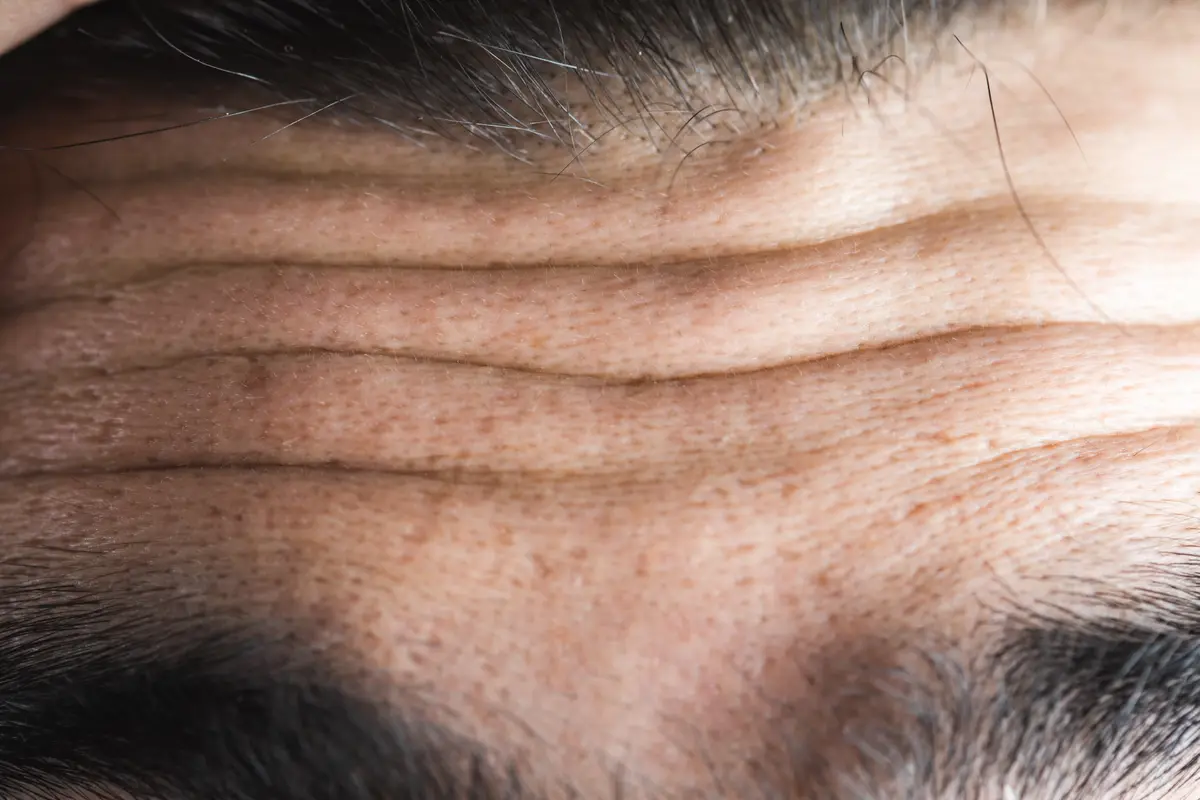
For many men, the first lines appear in the 30s and only show with expression: the “11s” when you concentrate, forehead creases when you raise your brows, crow’s feet when you laugh. When your face relaxes, the skin goes smooth again. These are dynamic lines, and they are what preventive treatment targets.
The approach is lighter than a full treatment: smaller doses, sometimes longer gaps, aimed at softening the habit of the muscle rather than stopping it. The idea is that a crease folded thousands fewer times etches in more slowly. One long-term look at this is a case report on identical twins in which one sister was treated two to three times a year for 13 years and had no forehead or frown lines visible at rest, while her rarely treated twin did.
A 2025 systematic review of preventive use found that early treatment may delay dynamic wrinkles and limit static lines over time, but called the data heterogeneous and said long-term safety and efficacy are not fully established. So prevention is a reasonable option, not a requirement. Our page on preventative BOTOX for men explains what a typical plan involves.
How is treatment different in your 40s and 50s?
By the 40s, many lines have started to stay. A forehead that creases on movement for years eventually holds a faint line at rest, and by the 50s those static lines are often deeper, joined by some volume loss in the temples, cheeks or under the eyes.
BOTOX still helps here, but the job changes. Relaxing the muscle stops the line from deepening further and softens it, yet a crease etched into the skin rarely disappears with a muscle relaxer alone. Men with strong muscles may also need fuller doses; a trial in men with frown lines found 40 units or more worked better than the 20-unit label dose.
That is why treatment for this age group often becomes a combination: BOTOX for the moving lines, dermal fillers for lost volume, and a resurfacing option such as the VI Peel for men for skin texture.
| Decade | Typical lines | Main goal | Common plan |
|---|---|---|---|
| 30s | Show only on movement | Slow the creasing | Light, preventive doses |
| 40s | Faint lines at rest beginning | Soften and stop deepening | Standard doses for male muscle |
| 50s and beyond | Etched lines, some volume loss | Soften and restore | BOTOX plus filler or a peel |
Everyone ages on a different clock. Sun exposure, smoking, genetics and how expressive you are move these lines earlier or later, so the table describes patterns, not rules. Our page on forehead lines in men goes into the causes.
Is there a downside to starting early?
The main cost is commitment of time and money, since each treatment lasts months rather than years. Starting early also means more treatments over a lifetime, which is one reason the label favors the lowest effective dose at the longest practical interval: it keeps the small chance of antibody resistance down. Our answer on whether BOTOX is safe long term covers that risk.
There is no penalty for stopping. If you decide preventive treatment is not worth it, the muscles return to their usual movement.
How Ultimate Male helps you decide
At Ultimate Male, the aesthetic and men’s health nurses start by watching how your face moves and looking at your lines at rest. If they are purely dynamic, you hear whether light preventive dosing makes sense or whether waiting is just as reasonable. If they are etched, you get an honest view of what BOTOX will and will not do, and what to pair it with.
There is no pressure to start on any particular timeline. When you are ready, compare BOTOX, XEOMIN and Jeuveau on our wrinkle relaxers page, or prepare with our first aesthetics consultation guide. Cosmetic treatment is generally not FSA or HSA eligible; financing is available through CareCredit, Prosper Healthcare Lending or Afterpay.
