
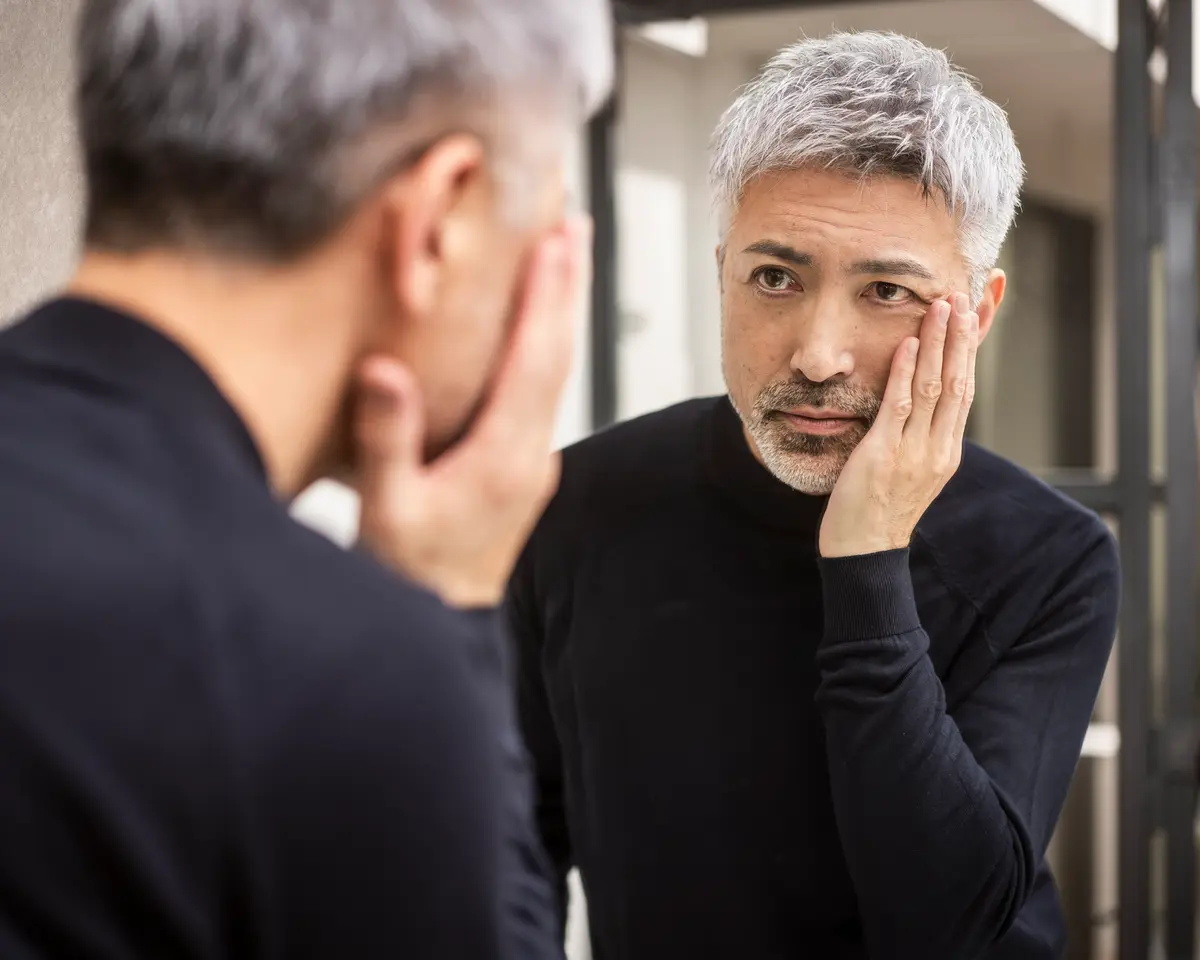
Why men get deep forehead lines
Forehead lines are creases that form across the forehead from years of raising the eyebrows, the job of a broad, flat muscle called the frontalis. Each time it contracts, the skin above it folds. Early on, the lines appear only when you move, which is why they are called dynamic. Over time, sun exposure and loss of collagen let them stay etched in at rest.
Men often develop these lines with a few distinct features. Their foreheads tend to be taller, their frontalis muscles stronger, and their skin thicker, so lines can be fewer but deeper. Years outdoors without sunscreen, common among men who work or train outside in Southern California, add to it.
The lines themselves are harmless. Whether to treat them is a cosmetic choice, and the goal for most men is softer, rested-looking lines with natural movement rather than a smooth, motionless forehead.
Why men usually need more units
Men often need more wrinkle relaxer than label starting doses, because stronger muscles take more to relax. The clearest evidence comes from the frown area between the brows. In a randomized dose-ranging study of 80 men, doses of 40, 60 and 80 units of onabotulinumtoxinA worked better and lasted longer than 20 units for frown lines, without more side effects at the higher doses. The authors concluded men benefit from starting doses of at least 40 units there.
For the forehead itself, the labels give a baseline, not a rule. The BOTOX Cosmetic label uses 20 units across 5 points in the frontalis for forehead lines, given together with 20 units for frown lines. The XEOMIN label also uses 20 units in five injections for forehead lines, placed at least 2 cm above the bony rim of the eye socket. These figures are context only: your injector sets the dose after watching how your muscles move.
Units also do not transfer between brands. The BOTOX Cosmetic label states that its units cannot be compared to or converted into units of any other botulinum toxin product. For more on the numbers, see how many units of BOTOX men need.
Keeping the brow from dropping or arching
Placement keeps the result masculine and natural, and it matters as much as the dose. The frontalis is the only muscle that lifts the brows, so relaxing too much of it, or too close to the brow, lets the brows sit lower and feel heavy.
Careful injectors protect against two common problems:
- A dropped, heavy brow. Staying well above the brow and leaving the lowest band of muscle some movement keeps the brow from settling. The BOTOX Cosmetic label pairs forehead treatment with frown-line treatment specifically to minimize the chance of brow drooping, and its forehead trials reported brow drooping in 2 percent and eyelid drooping in 2 percent of treated patients.
- A surprised or arched brow. If the center of the forehead is relaxed while the outer edges keep pulling, the tails of the brow can lift into a peaked shape that reads as feminine or startled. A small, balanced amount at the outer forehead keeps the brow line flat and straight, which suits most men’s faces.
Conservative dosing on the first visit, with a check at two weeks, lets your injector fine-tune without overshooting. Worried about looking frozen? Our page on whether BOTOX will make you look frozen covers how natural results are planned.
BOTOX, XEOMIN or Jeuveau for the forehead
All three relax the frontalis in the same basic way, but their FDA-approved uses differ.
| Product | Approved for forehead lines? | Notes |
|---|---|---|
| BOTOX Cosmetic (onabotulinumtoxinA) | Yes | Label also covers frown lines, crow’s feet and neck bands |
| XEOMIN (incobotulinumtoxinA) | Yes, as part of upper facial lines | Has no accessory proteins; label allows simultaneous treatment of forehead, frown lines and crow’s feet |
| Jeuveau (prabotulinumtoxinA) | No | The Jeuveau label covers frown lines only, so forehead use is off-label |
Our comparisons of BOTOX vs XEOMIN and BOTOX vs Jeuveau go further, and the dedicated page on BOTOX for forehead lines in men walks through the treatment visit.
What to expect and how long it lasts
Results build over several days and are usually settled by about two weeks. The American Academy of Dermatology notes that improvements last about 3 to 4 months, and sometimes longer. Mild redness, small bumps at injection points, headache and occasional bruising are the common short-term effects. Our BOTOX aftercare guide for men covers what to do and avoid in the first day.
Timing matters if you have an event coming up. Book at least two weeks ahead so the result has settled and any touch-up can be done in time. Men in their 30s whose lines show only with movement sometimes start with lighter, less frequent sessions; our page on preventative BOTOX for men explains when that approach makes sense.
When a reaction needs urgent care
Serious reactions are rare, but they need emergency help, not a follow-up visit. Call 911 for trouble swallowing, speaking or breathing, or for new muscle weakness away from the treated area, which the labels warn can occur if the toxin spreads. Call 911 for hives with swelling of the face or throat. Drooping of the eyelid or brow is not an emergency, but call the clinic so your injector can assess it.
How Ultimate Male treats forehead lines in men
Forehead treatment at Ultimate Male starts with a look at how your face moves, not a preset number of units. At our San Gabriel and Downey clinics, a provider or one of our aesthetic nurses watches you raise and lower your brows, maps where the muscle pulls hardest, and checks the frown area that works against it. Doses are set for your face and kept conservative on a first visit.
You will get a clear plan before anything is injected, and a quote before you book. Cosmetic wrinkle relaxer treatment is generally not an eligible FSA or HSA expense, since IRS Publication 502 excludes cosmetic procedures; our page on using an HSA for cosmetic treatments explains the details. Financing through CareCredit, Prosper Healthcare Lending and Afterpay is available, and you can learn more about the options on our wrinkle relaxers page.
