

Why your TRT isn’t working
When TRT isn’t working, the problem is often the protocol around the testosterone rather than the testosterone itself. You started TRT expecting more energy, stronger libido, better recovery, improved mood and stronger erections.
But months later, you may still feel exhausted, mentally foggy, emotionally flat, inconsistent in the gym or frustrated in your relationship.
The problem may not be testosterone itself. The problem may be your protocol. Often it is a starting plan that was never adjusted to the man’s labs and symptoms, which is exactly the kind of issue a careful review can fix.
TRT is more than just “taking testosterone”
TRT works when the whole system responds, not just when one number goes up. One of the biggest misconceptions in men’s health is: “As long as testosterone levels go up, you’ll feel better.” That’s not how optimization works.
Your body responds to:
- Injection frequency
- Estrogen balance
- SHBG levels, which decide how much testosterone is free to use (see our page on the free testosterone test)
- Sleep quality
- Stress
- Thyroid function
- Blood thickness (hematocrit)
- Metabolic health
- Absorption differences
Two men can have the exact same testosterone level and feel completely different. That’s why personalized TRT matters.
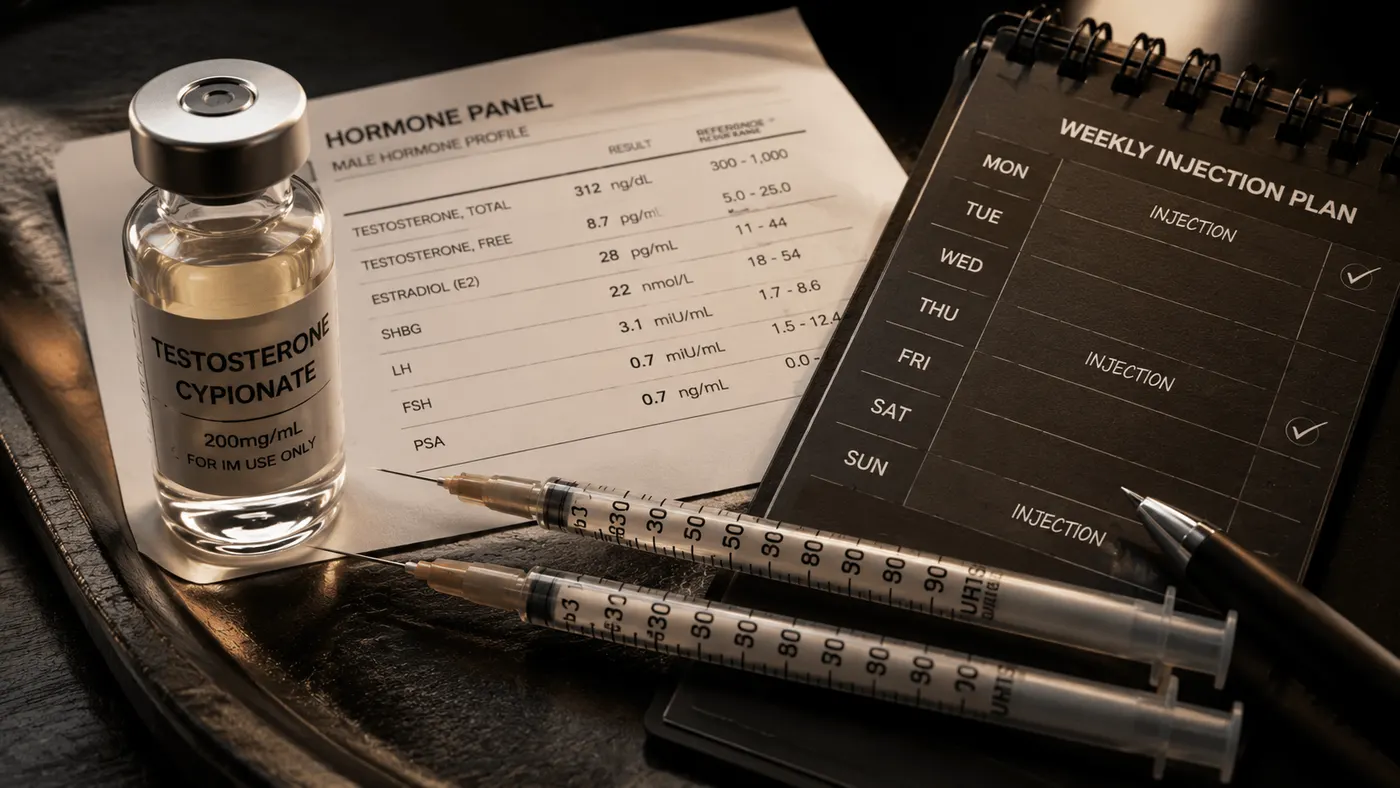
The most common reasons TRT fails
Most stalled TRT plans trace back to one of five problems, and several can overlap.
1. Your dose is too aggressive
Higher testosterone does not always mean better results. The AUA guideline recommends the minimal dose needed to reach the middle of the normal range, about 450 to 600 ng/dL, and found no data supporting above-normal levels for greater benefit.
Pushing levels too high can bring:
- Estrogen spikes
- Anxiety or irritability
- Water retention
- Acne
- A rising hematocrit
Libido and erections do not necessarily improve with a bigger dose either. Good care starts at a dose that leaves room to adjust and checks labs before raising anything. Our page on signs your TRT dose is too high lists what to watch for.
2. Your injection schedule doesn’t fit you
Large once-weekly or every-other-week injections create a peak in the days after the shot and a dip before the next one. Some men feel that as hormonal swings, a crash before the next injection, or mood and libido that rise and fall on a schedule.
Splitting the same weekly amount into smaller, more frequent doses, sometimes under the skin, gives a flatter curve and more stable levels. Whether that suits you is your provider’s call; our answer on weekly or twice-weekly testosterone injections explains the trade-offs. Consistency usually beats intensity.
3. Nobody is monitoring your estrogen properly
Estradiol is not “bad.” Men need healthy estrogen for erections, libido, mood, cardiovascular health and joints. The issue is imbalance.
Ignoring estradiol entirely and suppressing it heavily with aromatase inhibitors can both leave a man feeling unwell. It should be measured with a sensitive assay and managed in proportion to symptoms, as our guide to managing estrogen on TRT explains.
4. You were never fully evaluated
Low testosterone is often only part of the picture. You may also have:
- Sleep apnea
- Insulin resistance
- High cortisol
- Thyroid dysfunction
- Poor cardiovascular health
Sleep apnea is a good example of a problem that can hide behind low-T symptoms. The NHLBI suggests asking about it if you snore, gasp for air during sleep or feel excessively sleepy during the day, and our page on starting TRT with sleep apnea covers how the two are managed together.
This is why Ultimate Male puts heavy weight on preventative bloodwork, cardiovascular markers, hormone optimization, symptom tracking and ongoing adjustments.
5. Your plan tracks numbers, not symptoms
Total testosterone on its own is not enough to judge a plan. A complete review looks at:
- Free testosterone
- Estradiol
- SHBG
- CBC and hematocrit
- PSA
- Metabolic markers
- Symptoms, sexual function and energy consistency
Hematocrit deserves special attention. MedlinePlus explains that it is the percentage of your blood made up of red blood cells, and testosterone raises it. The AUA guideline treats a hematocrit of 54% or higher on therapy as a reason to intervene, usually starting with a dose adjustment.
Because optimization is about how you feel, not just what your lab sheet says.

What well-managed TRT should feel like
Well-managed TRT should feel steady rather than dramatic. When it is working, many men describe:
- Stable energy throughout the day
- Better gym recovery
- Healthier libido and improved erections
- More confidence, motivation and drive
Not:
- Emotional ups and downs
- Crashing before injections
- Bloating
- Feeling “off”
Not every man gets every benefit. The AUA guideline tells patients that therapy may improve sex drive, erectile function, depressive symptoms, lean body mass and bone density, while the evidence is inconclusive for energy, fatigue and thinking.
Some symptoms on TRT are emergencies, not reasons to book a review. MedlinePlus advises calling right away for chest pain or shortness of breath; with chest pain, sudden one-sided weakness or slurred speech, call 911.
Why men switch to Ultimate Male
Switching care is common and reasonable when a plan is not working. A second look at Ultimate Male covers every piece a TRT plan can be built from, and we customize:
- Dosing
- Injection frequency
- Delivery method: injections, oral Kyzatrex or pellets
- Fertility protocols, such as HCG
- Estrogen management
- Lifestyle recommendations
Because no two men respond the same way. If you are moving from another provider, our TRT transfer process is set up to avoid gaps in treatment while your labs are reviewed.
Ready to optimize your TRT?
If your current TRT protocol isn’t giving you the results you expected, it may be time for a second opinion. Bring your recent labs and dosing history to our San Gabriel or Downey clinic, where a PA-C or MD reviews everything with you one on one and orders same-day labs if anything is missing.
Call (626) 319-5261 or book a consultation to find out what a properly adjusted testosterone therapy plan could look like for you.
