
Who this guide is for
This guide is for men taking semaglutide or tirzepatide who want the weight they lose to be fat, not muscle. It matters most for men over 40, men who were already lean in the arms and legs before starting, and anyone losing weight quickly.
GLP-1 medicines take weight off mainly by cutting appetite. When you eat much less, the body takes some of what it needs from lean tissue unless you give it a reason not to. The Wegovy label notes that semaglutide removes more fat than lean mass, which is good news, but the lean share is still large. A 2025 joint advisory on GLP-1 nutrition reports that in the STEP 1 trial, about 38 percent of the weight lost was lean body mass, which includes muscle, organs and water. Because muscle is roughly half of lean mass, that corresponds to about 20 percent of the total being muscle. Modeling cited in the same advisory suggests muscle can make up 20 to 25 percent of weight lost in men without a structured plan.
Losing muscle lowers strength, makes daily tasks harder with age and makes regain more likely. The fix is unglamorous: enough protein and regular lifting.
Step 1: set your protein target
The general adult recommendation is 0.8 grams of protein per kilogram of body weight a day. The joint advisory notes that higher targets, such as 1.2 to 1.6 g/kg a day, have been proposed during active weight loss. Your provider sets your number, but this is how the math works.
- Convert your weight. Divide pounds by 2.2 to get kilograms.
- Multiply by 1.2 and by 1.6. That gives a daily range in grams.
- Sanity-check for larger bodies. The advisory points out that using actual body weight can overestimate needs in people with obesity, and that an absolute target of about 80 to 120 grams a day is a practical alternative. Your provider may base the target on a goal weight or your lean mass from a scan.
| Body weight | 1.2 g/kg | 1.6 g/kg | Practical note |
|---|---|---|---|
| 180 lb (82 kg) | About 98 g | About 131 g | Four meals of 25 to 33 g each |
| 220 lb (100 kg) | About 120 g | About 160 g | Upper end may be hard early; build toward it |
| 280 lb (127 kg) | About 152 g | About 203 g | Likely overestimates; a goal-weight or 80 to 120 g target may fit better |
The same advisory cautions against prolonged intake at or above 2 g/kg a day, so more is not automatically better.
Step 2: split protein across small meals
A large plate is hard to finish on a GLP-1, so spread protein across the day.
- Four or five small meals, each built around a protein source.
- Protein first. Eat it before the starch or vegetables while you still have room.
- Easy, compact sources: Greek yogurt, cottage cheese, eggs, canned tuna or salmon, chicken, tofu, lean ground turkey, milk or a protein shake.
- Liquid when appetite is lowest. Shakes or milk are easier than solid food in the day or two after an injection.
- Fiber and fluids alongside, to help with the constipation common on these medicines; see constipation on a GLP-1.
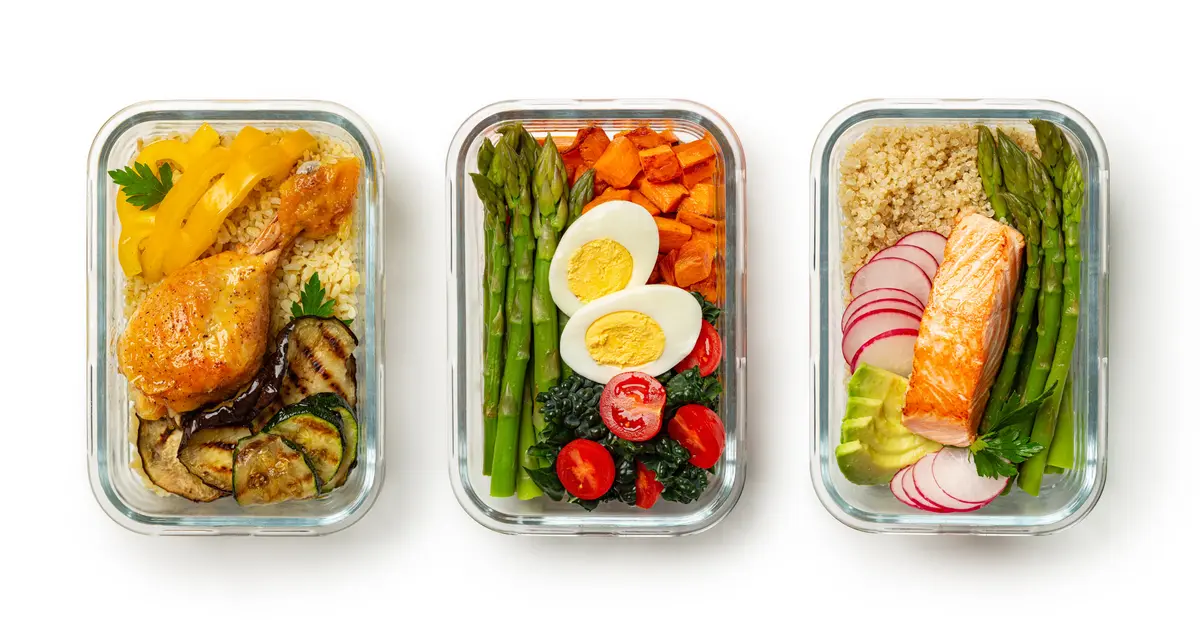
Sample day for a target of about 120 grams: Greek yogurt with berries (about 20 g), two eggs and a slice of toast mid-morning (about 15 g), a chicken and rice bowl at lunch (about 35 g), a protein shake in the afternoon (about 25 g), and fish with vegetables at dinner (about 25 g). Exact amounts vary by product, so read labels.
For more on targets, see protein intake on a GLP-1.
Step 3: a two-to-three-day strength routine
Strength training is the signal that tells your body to keep muscle while you lose fat. The CDC recommends muscle-strengthening activity on at least two days a week that works all the major muscle groups. The joint advisory goes further for people on GLP-1 medicines, recommending strength training at least three times a week plus at least 150 minutes of moderate aerobic activity.
A simple full-body session (do it two or three times a week, with a rest day between):
- Squat pattern: goblet squat, leg press or sit-to-stand from a bench
- Hinge pattern: Romanian deadlift with dumbbells or a hip bridge
- Push: push-ups (on a bench if needed) or a dumbbell chest press
- Pull: a dumbbell row or cable row
- Overhead or shoulders: a light dumbbell press
- Carry: walk while holding a heavy dumbbell in each hand
How hard: finish each set with a couple of repetitions left in reserve. Add a little weight or a few repetitions when the last set feels easy. Progress, not exhaustion, is the goal.
Plan around injection day. Many men feel queasiest in the day or two after a dose. Make those walking days and put the lifting sessions later in the week, when appetite and energy have recovered enough to eat a protein meal afterward. A small protein snack within a couple of hours of lifting is an easy way to bank part of the daily target.
Walking still counts. Daily walks support the aerobic target, but the advisory notes that aerobic exercise alone does less to protect lean mass during rapid weight loss than lifting. Men over 40 new to lifting will find a fuller program in strength training for men over 40.
Step 4: check that it is working
The scale cannot tell you what kind of weight you lost. Track waist, a body composition scan at sensible intervals and your lifts. If the scale is dropping, the waist is shrinking and your lifts are holding or rising, you are probably losing mostly fat. Our guide on how to track body composition progress shows how to record these numbers consistently.
Checklist and warning signs
- I know my daily protein target, agreed with my provider.
- I eat protein at every meal, first.
- I lift two to three days a week, covering legs, hips, back, chest, shoulders and arms.
- I walk most days.
- My lifts are holding or improving.
What to watch for: strength falling week after week, feeling weak or shaky during workouts, dizziness when you stand, or losing weight much faster than planned.
When to call the clinic: you cannot reach even half your protein target because of nausea, workouts leave you lightheaded, or your scan shows lean mass dropping faster than expected. Our page on muscle loss on semaglutide explains what can be adjusted.
When to call 911: chest pain or pressure during exercise, fainting, severe shortness of breath, or sudden weakness on one side of the body.
How Ultimate Male protects muscle during weight loss
At Ultimate Male, medical weight loss is built for men, with a focus on strength and daily performance rather than the number on the scale alone. Every plan at our San Gabriel and Downey clinics starts with labs and a body composition analysis, so your provider can see your starting lean mass and set a protein target that fits your kidneys, weight and training.
At check-ins, your provider compares weight with scan results and asks about your lifts, then adjusts the plan if muscle is slipping. To start, call 626-319-5261 for the free 10-minute phone call or book a weight loss consultation.