
What do the national numbers show?
Wrinkle relaxers dominate. The American Society of Plastic Surgeons’ 2025 statistics found that neuromodulators, the family that includes BOTOX, XEOMIN and Jeuveau, accounted for half of all minimally invasive cosmetic treatments that year. Hyaluronic acid fillers came second at 30 percent, followed by laser skin treatments. Those figures cover all patients, not only men.
Men’s choices are less well studied, but one recent study points to a clear pattern: men tend to want structure rather than fullness. In a 2025 study comparing treatments by sex and age, the jawline accounted for 31.3% of filler injections in men compared with 5.3% in women, while women had more filler in the lips and chin. Men also received larger toxin doses in the muscle between the brows. The study was small, with fewer than 20 men in each treatment group, so read it as a pattern rather than a rule.
Why are wrinkle relaxers such a common first step?
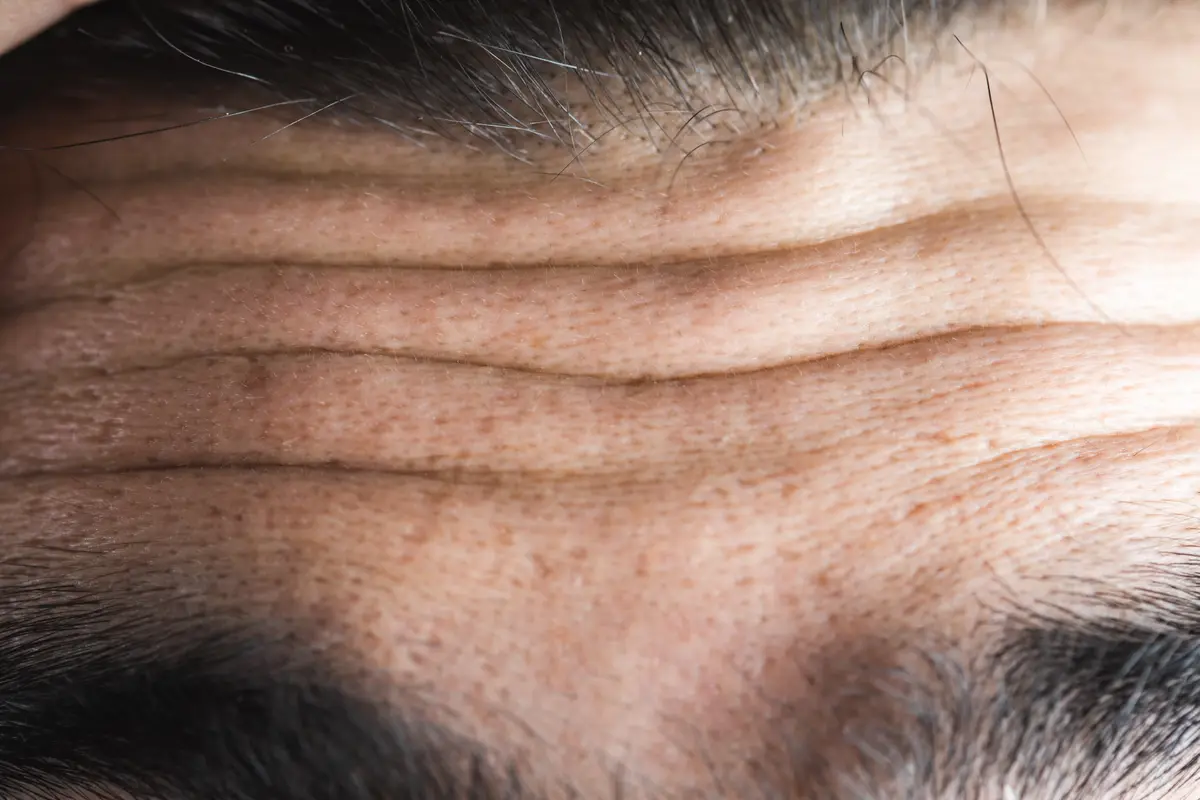
They solve the most common complaint with the least commitment. The lines men notice first are the horizontal forehead lines, the vertical “11s” between the brows that make them look angry or tired, and crow’s feet. All three come from muscle movement, which is exactly what a relaxer softens.
The time commitment is small. The American Academy of Dermatology says most people see results within 3 to 7 days and that improvement lasts about 3 to 4 months. If you are wondering when to begin, our answer on what age men start BOTOX looks at the timing.
What about jawline filler, PRP hair and pigment treatment?
Each of the next three answers a specific male concern.
- Jawline filler. A jawline that softens with age or weight change is a common reason men consider filler. RADIESSE (+) received FDA approval in 2021 for improving moderate to severe loss of jawline contour in adults over 21. Our jawline filler for men page explains the treatment.
- PRP for thinning hair. Platelet-rich plasma is not FDA-approved for hair loss, and the evidence is mixed to promising. It appeals to men who want to support thinning areas without surgery; our hair restoration page lays out who tends to do well.
- Sun spot and pigment treatment. Decades of driving, sports and outdoor work show up as brown spots on the cheekbones, temples and hands. PicoSure Pro and the VI Peel are the two tools here, and our answer on choosing a VI Peel or PicoSure helps you match them to your skin.
What does a typical first visit look like by age?
There is no fixed formula, but concerns shift with age in predictable ways, and so do common starting points.
| Age | What men usually notice | A common first-visit starting point |
|---|---|---|
| 30s | Frown lines and forehead lines that linger after expressions; early sun spots; early thinning | A wrinkle relaxer, a sun protection plan, and a hair evaluation if thinning has started |
| 40s | Lines visible at rest, early cheek flattening, more sun spots | A wrinkle relaxer plus either pigment treatment or a modest cheek or jaw filler |
| 50s and 60s | Softer jawline, deeper folds, hollow temples or under-eyes, widespread sun damage | A relaxer with structural filler such as RADIESSE or Sculptra, and a peel or laser plan for pigment |
Many men also start with just one thing and add more later. That is a sensible way to learn how your face responds.
How does a first plan come together?
The plan follows your face and your priorities, not a package. Some men want one change before a specific event. Others want a yearly routine that keeps them looking rested. Our guide to the first aesthetics consultation for men walks through what is asked and examined.
How Ultimate Male builds your plan
At Ultimate Male, aesthetic care sits inside a men’s health clinic, so the conversation is direct and the goal is a result nobody can point to. Our aesthetic nurses look at your face at rest and in motion, explain which of your concerns each treatment addresses, and tell you what they would leave alone.
Cosmetic treatments are paid per visit, and they are generally not FSA or HSA eligible; our answer on using an HSA for BOTOX explains the IRS line. Explore the full aesthetics menu, or call 626-319-5261 for a free 10-minute conversation before you book.
